 IGNITE

Every founder loves talking about the tools they built. Almost nobody tells you the real reason they built them: because they couldn't stand doing that thing one more time. I've spent ten years turning a twenty-minute quote into something that now takes under a minute, and the step that actually moved the needle wasn't the AI, the CRM, or the workflow engine sitting in the background. It was handing the keyboard to the customer.
That sentence still makes some business owners squirm when I say it out loud in a first meeting. Good. It should. It's the whole point of this post.
The question I ask before we talk about any tool
When I sit down with a client for the first time, before we get anywhere near AI tools for scaling a business or which platform to plug in, I ask one question: what's the task in your day you'd pay someone else good money to never touch again?
Not "what's repetitive." Not "what takes the most hours." What do you hate?
I ask it that way on purpose. Every operations consultant on earth will tell you to automate what's repetitive and necessary. That's true, but it's incomplete, and it's why so many automation projects in Latin America stall out after the kickoff meeting. Repetitive tells you what CAN be automated. Hate tells you what SHOULD be automated first, because hated tasks quietly turn into bottlenecks even when they're technically simple. You put them off. You do them badly. You let them sit in a browser tab for three days. A ten-minute task you hate ends up costing you way more than ten minutes, because of everything it delays around it.
Ten years, one hated task, and a lot of half-measures
Quoting was my hated task. For years, building a quote meant opening a spreadsheet, hunting down the right price list version, copying specs from a PDF, formatting it so it didn't look like garbage, and emailing it off hoping the customer hadn't already gone somewhere else. Twenty minutes if nothing went wrong. And something always went wrong.
I didn't fix this in one clean move. I fixed it in layers, over ten years, mostly because I kept hitting the wall of my own irritation and deciding to do something about the next piece of it. First I automated the pricing lookup. Then the formatting. Then the follow-up, because I was just as guilty of quoting someone and then forgetting to chase them as any sales rep I've ever managed. Each layer was a small project on its own. None of them alone was the breakthrough. What I built over that decade eventually became the quoting system I use with clients today, where a quote goes out by email or WhatsApp in under a minute and keeps following up on its own until someone answers.
Here's the part nobody wants to hear: none of that speed matters if the input feeding it is a mess. Before you shave a process down to sixty seconds, you have to do the unglamorous work of standardizing your price lists, your specs, your product data. Automation doesn't fix chaos, it just makes chaos happen faster. If you want a real answer to what business automation actually is beyond the buzzwords, I wrote a whole plain-English breakdown of business automation that covers exactly this, because it isn't a tech project. It's a process decision you make before you touch a single tool.
The step that scared me
Here's where it gets uncomfortable. After I'd automated the backend and cut the actual assembly of a quote down to almost nothing, the process still had a bottleneck: me, or a rep, gathering the customer's requirements in the first place. A call, an email back and forth, a WhatsApp voice note explaining what they needed. That part was still manual, still slow, and honestly, still kind of the fun part of sales for a lot of people, which is exactly why nobody wanted to touch it.
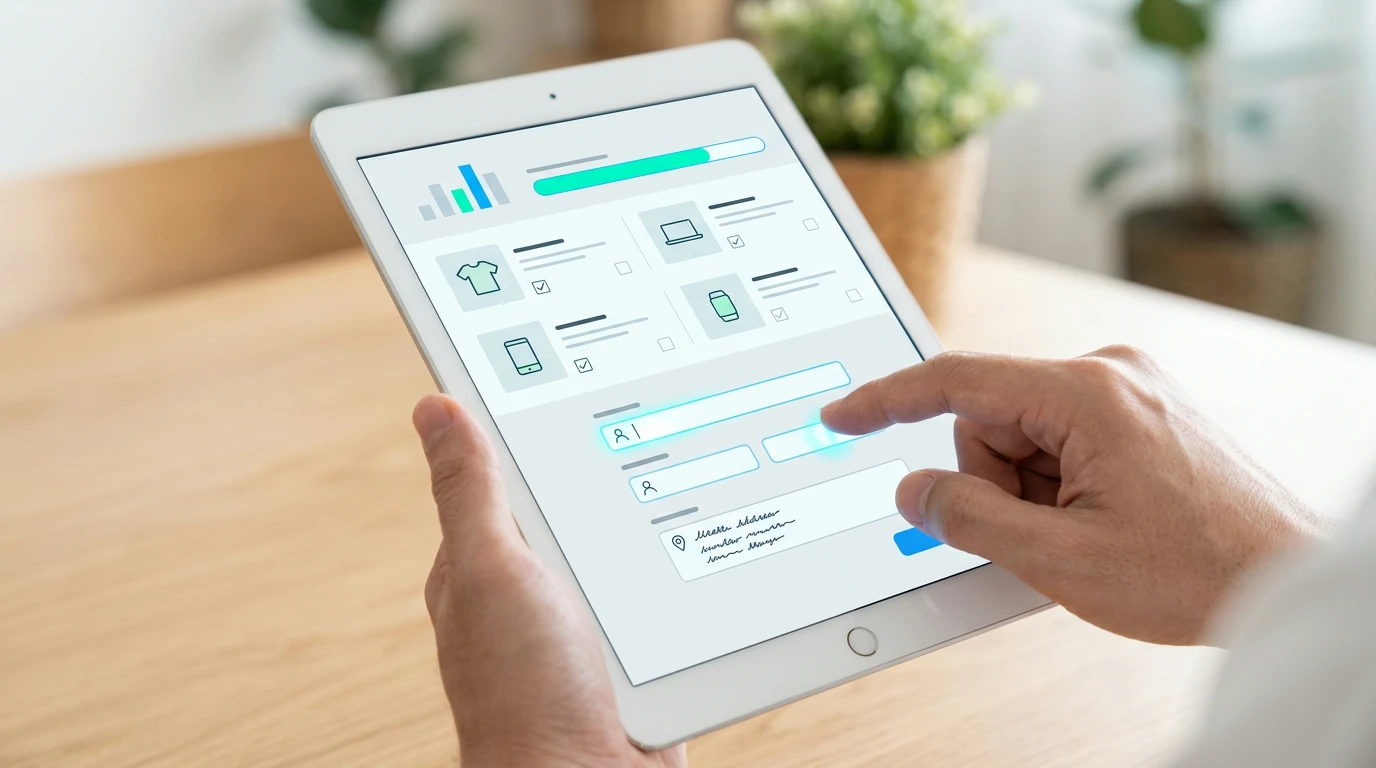
So I did the thing that felt like giving something away: I built a form. I let the customer fill out their own quote request. No call needed, no rep gatekeeping the information, no "let me check and get back to you." Just a structured form that captured what a rep would have asked anyway, feeding straight into the system that builds the quote.
I expected this to feel like a downgrade, like I was replacing a real sales conversation with a cold, impersonal form and calling it progress. What actually happened was the opposite. The customers who filled out the form were, on average, further along in their decision than the ones who called. They'd already compared us to alternatives. They already knew roughly what they needed. The form wasn't replacing the sales conversation, it was filtering out who deserved one.
That's the twist nobody tells you about self-service: it's not a lesser version of sales, it's a qualification filter. The tire-kickers who just want a number to compare rarely bother finishing a detailed form. The buyers who are actually ready fill it out completely because they want the answer fast. Self-service does the sorting for you before a human ever picks up the phone.
Your customers are already ahead of you here

If you run a distributor or a tech-adjacent business in Latin America, I'd bet money your website still makes people call or email just to get basic pricing. Meanwhile your customers are already living in a world of self-checkout, no-agent bookings, and one-click reorders everywhere else in their lives.
A 2025 research report from Latamclick on B2B marketing in Latin America projects that 83% of B2B transactions in the region are trending digital, and more than a third of millennial B2B buyers actively prefer dealing directly with a self-service platform over going through an intermediary. Read that again: buyers are asking for less human contact in the early stages of a purchase, not more. The businesses that still make you talk to someone before you can even see a price are working against their own customers' preferences, not for them.
But before you go rebuild your entire commercial operation this weekend, let me hand you the other half of the data, because I think overselling AI adoption to traditional businesses is exactly how these projects fail. The World Economic Forum's report on Latin America in the intelligent age found that 59% of small and medium businesses in the region report generating no measurable value from AI. Fifty-nine percent. That's not a tooling problem, that's a targeting problem. Most businesses are automating for the sake of saying they use AI, not because they identified a real bottleneck first.
That's exactly why the hate criterion matters more than the technical one. Automate a process nobody cares about, and you just get a shinier version of a task that was never the problem. Automate the thing that's actually costing you time, morale, and deals slipping through the cracks, and you get AI ROI for small teams you can point to and explain in one sentence, because you lived the before and after yourself.
What this actually looks like when it works
Quoting was my example because it's the one I lived through for a decade, but the same logic applies everywhere I've touched a client's commercial operation. Support questions eating up a sales rep's morning is a hated task, which is why building an AI customer service knowledge base that pulls support tickets out of the sales inbox tends to get adopted fast and used correctly: the person receiving the relief was the one who asked for it. Chasing cold leads by hand is a hated task too, which is part of why an AI lead outreach tool that handles the first round of outbound tends to stick, the same way it did when we built one from scratch to land fifty qualified leads without spending a cent on ads. Writing dev tickets was a hated task of mine personally, which is the whole reason I stopped writing them the normal way and built a tool I just talk to instead.
Notice what these all have in common. None of them required a development team on staff. Business automation without a dev team is entirely realistic in 2025, and it's one of the biggest misconceptions I run into with midsize companies in Latin America: the assumption that real automation means hiring engineers. It doesn't. It takes clarity about what's actually costing you time, and the discipline to standardize the process before you speed it up.
An academic study on AI-powered sales quote generation found that automating this exact process cut average sales-cycle length by nearly 38%, from about 27 days down to 17. That's not my number, that's from an independent study on quote automation and sales cycles, but it lines up with what I saw firsthand: real-world AI business results show up when the automation attacks a bottleneck that was already visible to everyone doing the work.
So here's my actual advice, the kind that doesn't need a slide deck. Forget the audit. Forget the process map. Ask yourself, or your team, the same question I ask every client: what's the task you'd pay someone else to never make you do again? Start there. Standardize it. Then ask if there's a version of it where the customer does part of the work themselves, because they're probably more ready for that than you think.
What's the task you've been putting off automating, not because it's hard, but because you just can't stand doing it?
FAQ
Why should I automate what I hate instead of what's just repetitive?
Hated tasks quietly become bottlenecks even when they're technically simple, because you put them off, do them badly, or let them sit unfinished. Repetitive tells you what can be automated, but hate tells you what should be automated first.
Does letting customers fill out their own quote request hurt the sales relationship?
No, it actually works as a qualification filter. Customers who complete a detailed form are usually further along in their decision and ready to buy, while tire-kickers rarely bother finishing it.
Do I need a development team to build something like this?
No, business automation without a dev team is entirely realistic in 2025. What it actually takes is clarity about what's costing you time and the discipline to standardize the process first.
Why do so many AI automation projects fail to deliver value?
Because most businesses automate for the sake of using AI rather than targeting a real bottleneck first, which is why a majority of small and medium businesses in Latin America report no measurable value from AI.
What should I do before speeding up a process with automation?
You need to standardize your price lists, specs, and product data first, since automation doesn't fix chaos, it just makes chaos happen faster.
How do I figure out what to automate first in my own business?
Ask yourself or your team what task you'd pay someone else good money to never touch again, then standardize that process and see if part of it can be handed off to the customer.