 IGNITE
I used WordPress for a little over nine years. And I never liked it. Not once. Not even at the beginning, when you're supposed to be excited about the possibilities. That's the confession. Not that WordPress is bad — plenty of people build great things with it. The confession is that I knew it was wrong for me, kept using it anyway, and told myself it was fine.
That's the real problem. Not the platform. Me.
Why Smart People Keep Tolerating Bad Tools
Here's what happens. You pick a tool early, you invest time learning it, you build things on top of it, and then switching feels expensive. So you don't switch. You add a plugin to fix the thing that's broken. Then a plugin to fix the plugin. Then you spend a Saturday afternoon debugging why the site went down again, thinking, "I should really move off this at some point."
That was nine years of my life. Slow load times, unreliable hosting, plugin dependencies that broke every time something updated. The site was never fast. It was never truly mine. It was always one update away from a problem I didn't have time to solve.
I kept using it because switching had a cost, and I kept underestimating the cost of staying.
That's a trap a lot of business owners fall into, by the way. Not just with websites. With CRMs they don't use, with spreadsheets running sales processes that should be automated, with tools that technically work but create friction every single day. The switching cost feels real and immediate. The staying cost is invisible until it isn't.
The Moment I Actually Stopped
There was a specific moment. I'm not going to dress it up as a gradual awakening or a strategic decision. Something broke, I got annoyed, and I thought: I build custom systems for other people's businesses. I help clients get off manual processes and onto tools that actually fit how they work. Why am I running my own content on something that makes me want to close the laptop every time I open it?
That question ended nine years of tolerance in about thirty seconds.
The obvious next move would have been to pick a different off-the-shelf platform. Webflow, Squarespace, Ghost, whatever. And honestly, any of those would have been an improvement. But I kept coming back to the real problem, which wasn't the CMS. It was the content process itself.
Publishing consistently as a solo founder is genuinely hard. Not because the ideas aren't there. The ideas are always there. It's the translation from idea to published post to LinkedIn caption to newsletter to video script that kills you. That's five different formats, five different tones, five different moments where you sit down and think, "okay, how do I say this for this channel," and then two hours disappear.
So I Built the Marketing Machine
I spent a little over a month building what I now call the Marketing Machine. It's an AI-powered content tool, and the way it works is this: it interviews me.
Not the other way around. I don't sit down and write a brief or fill out a form or paste in a transcript. The Machine asks me questions. I answer them. My answers, in my words, with my opinions and my specific way of explaining things, become the raw material for everything that follows.
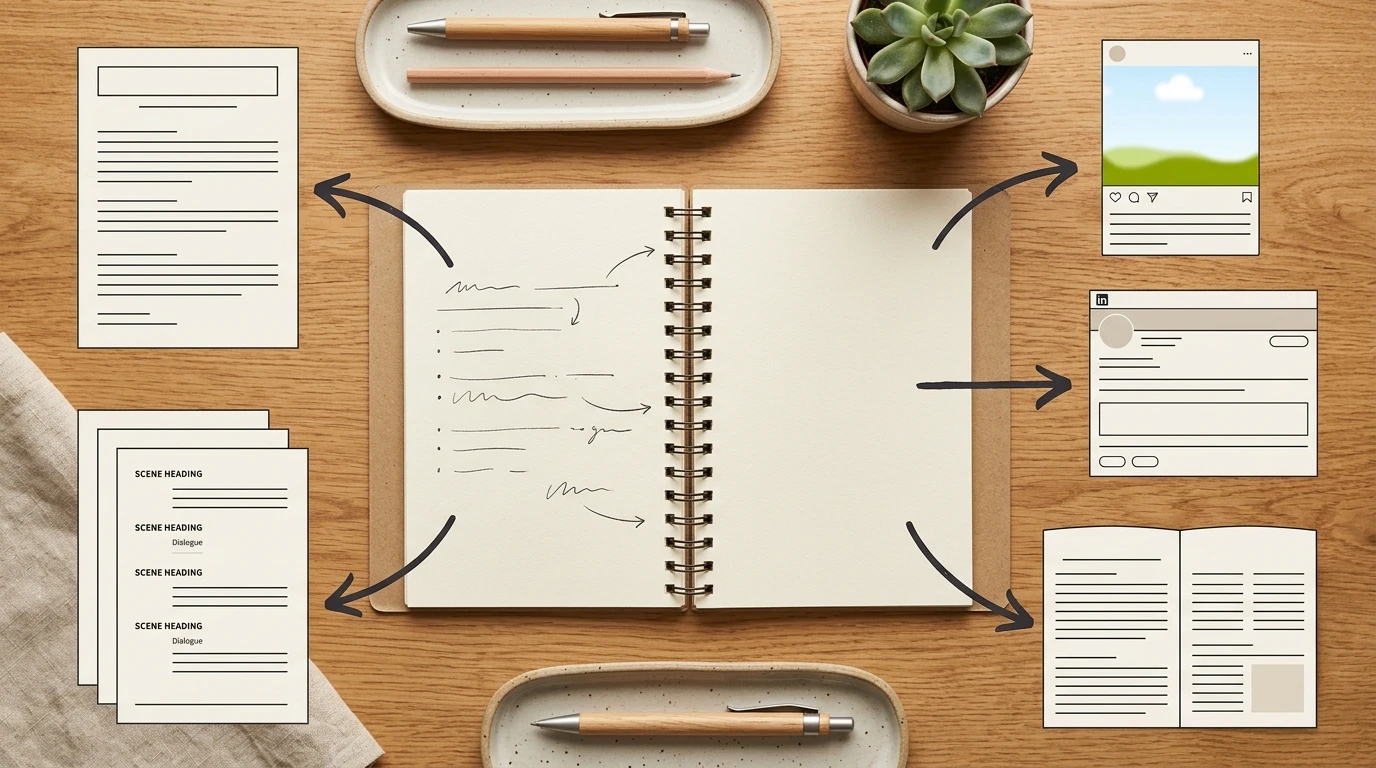
From one interview session, the Machine produces a blog post, social media content for LinkedIn, Instagram, and Facebook, a newsletter, and a video script.
One conversation. Five formats. Done.
The reason I built it this way, with the interview at the center, is voice. Most AI content tools flatten you. You put in a topic, you get back something that sounds like a competent but slightly boring version of every other piece on that topic. The voice is gone. The opinions are softened. The specific stories that make your content worth reading get replaced with generic examples.
The interview format flips this. The Machine extracts what I actually think, not what a language model guesses I probably think about a topic. The output still sounds like me because it started with me talking.
The Meta-Hook You Already Noticed
Here's the part I like best about this whole thing: this post came out of the Machine.
The blog post you're reading right now. The LinkedIn post that probably brought you here. The newsletter version of this story. The video script if you're watching instead of reading. All of it started with one interview session. I answered questions. The Machine did the rest.
That's not a claim I'm making about what the tool can do. That's a live demonstration. You're inside it right now.
I'm not going to pretend that's not a little bit satisfying after nine years of fighting with a platform I never liked.
What This Actually Solves
For Ignite, the content strategy depends on showing up consistently. The goal is to build an audience of business owners who already trust what I know before we ever have a sales conversation. That means publishing regularly, across multiple channels, without the content sounding like it was produced by a committee or a content farm.
The Marketing Machine solves the consistency problem without sacrificing the thing that makes the content worth consuming in the first place: a real point of view from someone who has actually built the things they're talking about.
This is also exactly the principle behind how I work with clients. Every tool I offer, I've already built and used in my own business. The Marketing Machine isn't something I designed theoretically and then handed off. I built it because I needed it. I've been running it for my own content. Now it's part of the stack I can offer.
It's the same logic behind how we moved support queries out of the sales inbox: build the system for yourself first, understand where it breaks, fix it, then bring it to clients. Recommending tools you've never actually used under real conditions is how you end up with implementations that look good in a demo and fall apart in week two.
The Part About WordPress I Actually Regret
Not using it. Tolerating it without questioning whether there was a better path.
There's a version of this story where I build the Marketing Machine three years ago. Maybe four. The AI capabilities weren't quite there yet, but the need was. The friction was real. I just kept absorbing it instead of solving it.
That's the thing about invisible costs. They compound. Every Saturday afternoon debugging a plugin issue, every time I put off publishing because the process felt heavy, every piece of content that didn't go out because I didn't have the bandwidth to produce it in five formats: that's all real cost. It just doesn't show up on a line item anywhere.
The businesses I work with have the same problem on the commercial side. Manual follow-up processes, no lead routing, salespeople doing work that a well-built automation could handle in seconds. The cost is real. It just doesn't look like a bill.
What Comes Next
The Marketing Machine is running. The content is going out. The nine years of WordPress are done.
If you're a founder or a business owner who recognizes the pattern I described, tolerating a tool or a process because switching feels expensive, the question worth sitting with is: what is staying actually costing you? Not in theory. In hours, in missed output, in the version of your business that exists if that friction disappears.
Sometimes the answer is "not that much, it's fine." But sometimes you do the math and realize you've been paying a tax you didn't know you were paying for nine years.
That's a good day to build something better.
FAQ
What is the Marketing Machine?
The Marketing Machine is an AI-powered content tool that interviews you and turns your answers into a blog post, LinkedIn content, Instagram and Facebook posts, a newsletter, and a video script all from one conversation. It is built around an interview format so the output keeps your actual voice and opinions instead of flattening them.
Why use an interview format instead of just giving the AI a topic or brief?
Most AI content tools produce something that sounds generic because they are guessing at what you probably think rather than capturing what you actually said. The interview pulls out your real words, stories, and opinions first, so the output starts from you rather than from a language model's best guess.
Is this post itself an example of the Marketing Machine's output?
Yes, this blog post, the LinkedIn content that may have brought you here, the newsletter version, and the video script all came from one interview session run through the Machine. It is a live demonstration, not just a description of what the tool can do.
What problem does this solve for solo founders specifically?
Publishing consistently across multiple channels is hard not because ideas run dry but because translating one idea into five different formats and tones is where the time disappears. The Machine collapses that process into a single conversation so content goes out regularly without the output sounding like it came from a content farm.
What is the real cost of sticking with a tool or process that creates daily friction?
The cost is mostly invisible, showing up as hours lost, content that never gets published, and work that compounds quietly over time rather than appearing on any invoice. The switching cost feels immediate and real while the staying cost only becomes obvious after you finally do the math.
Do you offer the Marketing Machine to clients?
Yes, and the reason is that it was built and tested inside the business first before being offered to anyone else. Every tool offered to clients has already been run under real conditions, because implementations that only work in a demo tend to fall apart in practice.